Live Fuel Prices Germany: How to Find the Cheapest E10, E5, and Diesel Near You
Learn how to compare live fuel prices in Germany, spot cheaper E10, E5, and diesel stations nearby, and make smarter fueling decisions before every drive.
By the Fahrnex Editorial Team · Reviewed by Umme Hanna Meskat
Fuel prices in Germany can change quickly, and the gap between one station and the next is often large enough to matter. For private drivers, that difference can quietly inflate the monthly cost of commuting. For multi-vehicle households and fleet teams, the effect is even more visible because a small price gap becomes a repeated operating cost. That is why a live fuel prices Germany tool is useful: it helps you compare nearby E10, E5, and diesel prices before you leave, instead of relying on guesswork, memory, or a long detour through several apps.
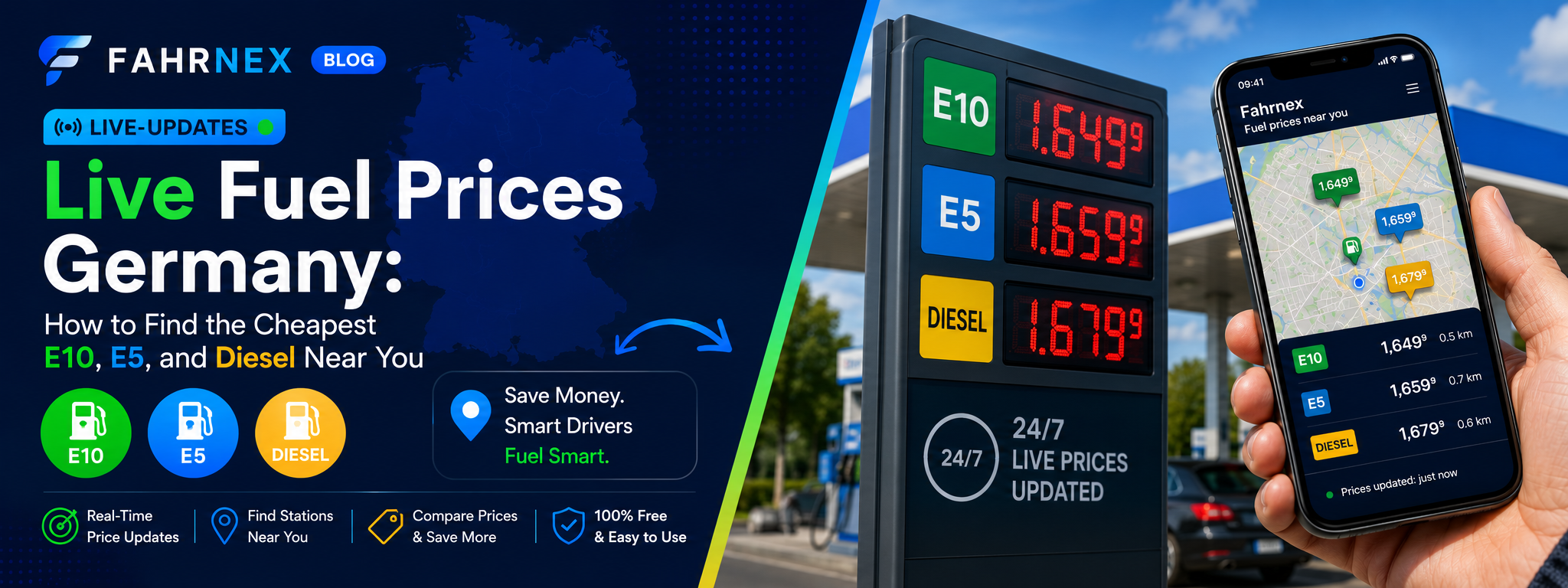
The goal is not to obsess over every cent. The goal is to make a fast and informed decision. When a tool shows current prices, location-aware nearby stations, and a clear cheapest-versus-nearest view, it becomes much easier to decide whether a lower price is worth the extra distance. The live fuel prices page gives you a cleaner view of nearby stations in Germany, with filters for fuel type, radius, and sorting, so the result is easier to scan and act on.
Data source and freshness: Covered public stations report every price change for Super E5, Super E10 and diesel to Germany's Market Transparency Unit within five minutes. Fahrnex receives the data through Tankerkönig and caches responses for reliability. Always read the displayed data time: clearly identified older fallback values may appear during an upstream outage, and the forecourt price remains decisive.
Why live fuel prices matter in Germany
Germany has a highly visible fuel market, but it is not a uniform one. Prices can differ between neighborhoods, ring roads, motorway locations, and urban side streets. Timing also matters. Drivers often notice that the same station looks different in the morning than it does later in the day. If you only fill up when the tank is already low, you usually lose the chance to compare calmly.
Using live price data changes that rhythm. Instead of discovering the price only when you are already standing at the pump, you can compare stations around your route first. That makes the decision more deliberate. It also reduces the tendency to choose the first visible station simply because it is convenient in the moment.
| Topic | Amount | Notes |
|---|---|---|
| Private drivers get a quick way to evaluate local price differences before travelling. | - | - |
| Families with more than one vehicle get better visibility across recurring weekly costs. | - | - |
| Fleet teams gain one more practical signal for controlling day-to-day operating expenses. | - | - |
Keep the next vehicle deadline visible without scattered paperwork.
Fahrnex connects reminders, documents, and service history so inspections and maintenance are easier to plan before they become urgent.
Create a free accountWhat makes E10, E5, and diesel comparisons useful
Many drivers are not just comparing one station against another. They are also comparing fuel types. If your vehicle supports E10, the price difference between E10 and E5 is often part of the decision. Diesel drivers are making a different comparison, but the same logic applies: local price visibility matters more than assumptions.
A good live fuel price page should therefore do more than list stations. It should help you filter by the fuel type that actually matters to your vehicle, because mixed or cluttered results slow down the decision. You can choose E10, E5, or diesel, narrow the search radius, and then sort by the option that fits your situation best.
When fuel-type filtering helps most
How to use live fuel prices without wasting time
The best price-check flow is short. If a driver needs too many steps, the tool stops feeling practical. A strong workflow looks like this:
| Topic | Amount | Notes |
|---|---|---|
| Open the Live Fuel Prices Germany page before you start driving or while planning a stop. | - | - |
| Use your current location or search a German area manually. | - | - |
| Select the correct fuel type | E10, E5, or diesel. | - |
| Set a radius that fits the trip. A smaller radius is usually better for quick local decisions. | - | - |
| Sort by cheapest price first when cost is the priority, or by nearest first when speed and convenience matter more. | - | - |
This matters because not every cheapest station is the best choice. A station that is only one or two cents lower may not be worth the extra drive if it adds time, traffic, or unnecessary distance. In other cases, the price gap is large enough that the detour makes sense. Good UX helps you see that tradeoff in seconds.
The most useful fuel-price tool is the one that helps you make a fast local decision with the least friction.
Cheapest station versus nearest station
This is one of the most important parts of fuel-price UX. Many users think they only want the cheapest result, but in practice they often need a balance between price and distance. If a station is slightly cheaper but noticeably farther away, the savings may not justify the trip. If it is both cheaper and close, that is a strong win. If it is nearby but marginally more expensive, convenience may still be the smarter choice.
That is why the tool highlights both the cheapest current rate and the nearest station. These are different decision anchors. The cheapest result supports cost-focused users. The nearest result supports convenience-focused users. Showing both makes the page more user-friendly because it reflects how people really choose where to fuel.
Check a detour with a transparent formula
Estimated benefit = price difference × litres purchased − extra kilometres × consumption ÷ 100 × estimated fuel price. For example, €0.02 per litre across 40 litres saves €0.80. A 6 km detour at 7 l/100 km and €1.75/l costs about €0.74 in fuel before time and wear are considered.
Choose cheapest-first when
Choose nearest-first when
Why current location support improves the experience
Location support is not just a convenience feature. It is a clarity feature. When the page knows where you are, the result becomes immediately relevant. You do not need to think about coordinates or broad regional searches. The tool can show nearby stations, sort them by distance or price, and make the result easier to trust because it clearly reflects your local context.
There are still times when manual area search matters. Some people want to check a destination before leaving home. Others want to compare stations around a work site, a delivery route, or a family visit. A strong live fuel price tool should support both. That combination makes the page more flexible for everyday driving situations and longer trip planning alike.
How this supports better vehicle cost control
Fuel is only one part of vehicle cost, but it is one of the most frequent and emotionally visible ones. Drivers notice fuel spend more often than they notice insurance, tax, or periodic maintenance because fueling is repetitive. That makes it a strong entry point into better cost awareness.
Once a user starts checking live prices before fueling, the next step becomes easier: tracking the longer-term cost picture. That is where a related tool such as the Fuel Cost Calculator becomes useful. Live prices help with the next fill-up. Cost tracking helps with the next month, quarter, or year. Together, they create a more complete decision system.
For fleet operators, this matters even more. A small saving per fill-up may look minor in isolation, but across multiple vehicles and repeated journeys it becomes operationally meaningful. The real benefit is not just lower spend. It is better visibility and calmer decision-making across the whole vehicle operation.
When checking live fuel prices is most useful
Checking live fuel prices is especially useful before routine commutes, longer trips, airport runs, delivery routes, and weekly refill stops. In all of these cases, the driver usually has enough time to compare nearby stations without turning the stop into a complicated exercise.
It is also useful when the tank is low enough that the next fill-up matters, but not so low that you are forced to choose the very first station you see. That small planning window is where a quick comparison can save money without creating stress.
| Topic | Amount | Notes |
|---|---|---|
| Before commuting, when you want a quick local check. | - | - |
| Before motorway or regional trips, when route planning already matters. | - | - |
| When prices feel unusually high and you want to compare your area before committing. | - | - |
| When you manage more than one vehicle and want a more consistent fueling habit. | - | - |
Best practices before you fuel up
Final takeaway
A good live fuel price experience should be fast, understandable, and genuinely useful. Users should be able to open the page, check current local prices, understand the cheapest-versus-nearest tradeoff, and act without friction. That is what makes a public tool worth returning to. If you want a simple way to compare nearby E10, E5, and diesel stations in Germany, start with the Fahrnex Live Fuel Prices Germany tool and pair it with the Fuel Cost Calculator when you want a broader view of your driving costs.
Frequently asked questions
How do I find the cheapest fuel station near me in Germany?+
Use a live fuel price tool that supports your current location, fuel-type filters, and sorting by cheapest price. The Fahrnex live fuel prices page helps you compare nearby E10, E5, and diesel stations quickly.
Is the cheapest fuel station always the best choice?+
Not always. A slightly cheaper station may be farther away, so the better choice depends on both price and distance. That is why comparing the cheapest and nearest station together is more useful than looking at price alone.
Can I compare E10, E5, and diesel separately?+
Yes. A proper fuel-price tool should let you filter by the fuel type your vehicle actually uses. This keeps the results clearer and avoids wasting time scanning stations that are not relevant to your next fill-up.
Why does current location matter for fuel-price search?+
Current location makes the results immediately relevant. Instead of checking a broad region manually, you can see nearby stations, compare local prices, and decide faster whether the cheapest or nearest option is the better fit.
How does live fuel price checking help with vehicle cost control?+
It improves one of the most frequent cost decisions drivers make. Over time, combining live price checks with tools such as the Fuel Cost Calculator helps users understand both immediate savings and broader fuel spending trends.
Fahrnex note
The calmest maintenance decisions usually come from keeping dates, receipts, and service history connected instead of scattered.
About this article
Fahrnex evidence check
How German live fuel-price data reaches Fahrnex
The review checked the statutory reporting chain against the Bundeskartellamt and compared the article with Fahrnex’s actual Tankerkönig integration, timestamp handling and cache fallback.
| Displayed item | Verified meaning | Limit |
|---|---|---|
| E5, E10 and diesel price | Covered public stations report each change to MTS-K within five minutes. | Reporting and a forecourt change can overlap; the price displayed at the pump controls the purchase. |
| Fahrnex response | Retrieved through the authorised Tankerkönig information service | Responses are cached for reliability and clearly older fallback data may be used during an upstream outage. |
| Distance | Supports a local comparison | The saving must be weighed against additional distance, consumption and time. |
| Location | Used to perform the nearby search | The driver remains responsible for route safety and fuel compatibility. |
Reviewed on 28 August 2026
- Verified MTS-K reporting chain
- Disclosed provider and cache limitations
- Removed savings guarantee language
- Added a reproducible detour calculation
Editorially reviewed on 28 August 2026. Sources:
The editorial team checked official sources against the Fahrnex product methodology. This article is not a substitute for case-specific technical, legal or tax advice.