8 Warning Signs Your Brakes Need Inspection or Replacement
Eight brake warning signs explained by urgency: when to stop safely, when to arrange a workshop visit, and what a professional brake inspection should measure.
By the Fahrnex Editorial Team · Reviewed by Umme Hanna Meskat
Brake noise, a soft pedal, or a dashboard light does not automatically mean that the brake pads alone need replacement. A braking system includes pads, discs or drums, calipers, lines, hoses, fluid, brake assistance, ABS, and stability-control components. Similar symptoms can therefore have different causes and levels of urgency.
This guide helps drivers assess eight warning categories without pretending to diagnose a car remotely. If braking force suddenly falls, the pedal sinks without normal resistance, brake fluid is leaking, smoke appears, or a red brake warning remains after the parking brake is released, do not continue the journey. Stop somewhere safe, follow the owner’s manual, and call roadside assistance when uncertain.
Quick answer: can I keep driving?
| Situation | Urgency | Recommended response |
|---|---|---|
| Sudden loss of braking, pedal falls through, visible fluid leak | Critical | Stop safely, do not continue, arrange roadside recovery |
| Red brake warning remains with parking brake released | Critical | Interrupt the journey, check the manual, use roadside assistance if uncertain |
| Smoke, sharp burning smell, or severely overheated wheel | Critical | Stop safely, stay clear of hot parts, do not cool with water, obtain professional help |
| Yellow pad-wear warning with no other symptoms | Prompt | Check the manual and arrange a workshop appointment soon |
| Recurring squeal or mild vibration with normal braking | Inspect soon | Avoid demanding use and schedule diagnosis; stop if it worsens |
Colours and symbols vary by vehicle. The ADAC warning-light guide distinguishes a general red brake warning from a yellow pad-wear indicator. The owner’s manual remains authoritative for the particular car.
Keep the next vehicle deadline visible without scattered paperwork.
Fahrnex connects reminders, documents, and service history so inspections and maintenance are easier to plan before they become urgent.
Create a free account1. Red brake warning or yellow wear indicator
A red brake warning with an exclamation mark may simply indicate an applied parking brake, but it can also point to low brake fluid, worn pads, or a braking-system fault. If it stays illuminated after the parking brake is fully released, do not treat it as an ordinary service reminder.
A separate yellow pad-wear indicator usually means that one or more monitored pads are approaching their wear limit on equipped vehicles. Not every wheel and not every car uses the same sensor arrangement. The absence of a warning therefore does not prove that every pad and disc is healthy.
2. Soft, spongy, or sinking brake pedal
A sudden change in pedal travel, or a pedal that moves unusually far without normal resistance, may indicate a problem with hydraulic pressure. Possible causes include air, fluid loss, damaged lines or hoses, a master-cylinder fault, or another component failure.
This is not a symptom to investigate with a DIY road test. The ADAC brake-fluid guide advises against continuing when braking weakens, the pedal can be pressed very easily, or response is delayed. Do not simply top up brake fluid without establishing why the level fell.
3. Longer stopping distance or weaker deceleration
If the car needs more pedal effort or takes longer to stop under comparable conditions, the braking system may be impaired. Wet or icy roads, tyres, load, and temperature also affect stopping distance. Do not attempt a risky emergency-stop test in public traffic to confirm a suspicion.
A sudden or substantial loss of performance calls for safe stopping and professional help. A gradual change also deserves prompt brake-test equipment because a driver can become accustomed to a slowly deteriorating response.
4. Vehicle pulls to one side under braking
If the vehicle moves distinctly left or right only while braking, force may be uneven across an axle. Potential causes include a sticking caliper, unequal or contaminated friction surfaces, a hydraulic problem, or a tyre or suspension fault.
Severe pulling reduces control, especially in wet conditions or an emergency. A workshop needs to measure the cause; replacing one pad on a guess is not a dependable repair.
5. Pedal pulsation, judder, or steering vibration
Pulsation during ordinary braking is often described casually as a “warped rotor.” Other possibilities include disc runout, uneven friction deposits, disc-thickness variation, corrosion, installation error, or a wheel, tyre, or suspension problem. Pedal pulsation during ABS operation in a hard stop may be normal.
Context and repeatability matter. Recurring judder during routine deceleration should be measured. Replacing parts without checking disc thickness, runout, hub surfaces, and related chassis components can leave the root cause unresolved.
6. Metallic grinding or scraping
A metallic grinding noise can occur when friction material is severely worn and components make unwanted contact. A trapped object, backing plate, or another fault can create a similar noise. It is particularly urgent when combined with weak braking, pulling, or a warning light.
Continued driving can damage discs and other components and compromise safety. Stop safely and arrange recovery or movement based on professional advice rather than trying to “clean” the noise through repeated braking.
7. Recurring squealing
Squeal alone does not prove that a pad is worn out. Moisture, light surface corrosion after parking, dust, friction material, glazing, missing damping, or a mechanical wear tab can produce similar sounds. A brief noise after washing may disappear; persistent or increasing squeal deserves inspection.
Look at the combination of signs. Squeal accompanied by reduced performance, a warning, pulling, or changed pedal feel is more urgent than an isolated noise with normal braking.
8. Burning smell, smoke, or an unusually hot wheel
A sharp smell, smoke, or intense heat at one wheel can indicate a dragging brake, seized caliper, severe thermal load, or a parking brake that has not fully released. Brakes can become extremely hot, so do not touch the wheel, disc, or caliper.
Stop in a safe location, switch off, and keep clear of hot components. Do not pour water over the brake. Smoke, a persistent smell, a locked wheel, or changed braking performance requires professional assistance.
Why mileage is not a replacement rule
Brake pads have no universal replacement mileage. Wear varies with vehicle mass, brake design, pad material, urban versus motorway use, terrain, towing, driving style, and regenerative braking. A generic rule such as “always replace at 3–4 mm” cannot replace the manufacturer specification, component design, and correct measuring point.
The ADAC maintenance guide emphasises the strong effect of driving style and operating conditions and recommends inspection during scheduled maintenance. A workshop compares measured figures with manufacturer limits and the condition of the complete axle.
What does a professional brake inspection include?
| Item | Inspection method | Why it matters |
|---|---|---|
| Brake pads | Measure inner and outer friction material and compare wear patterns | An outside view can miss a badly worn inner pad. |
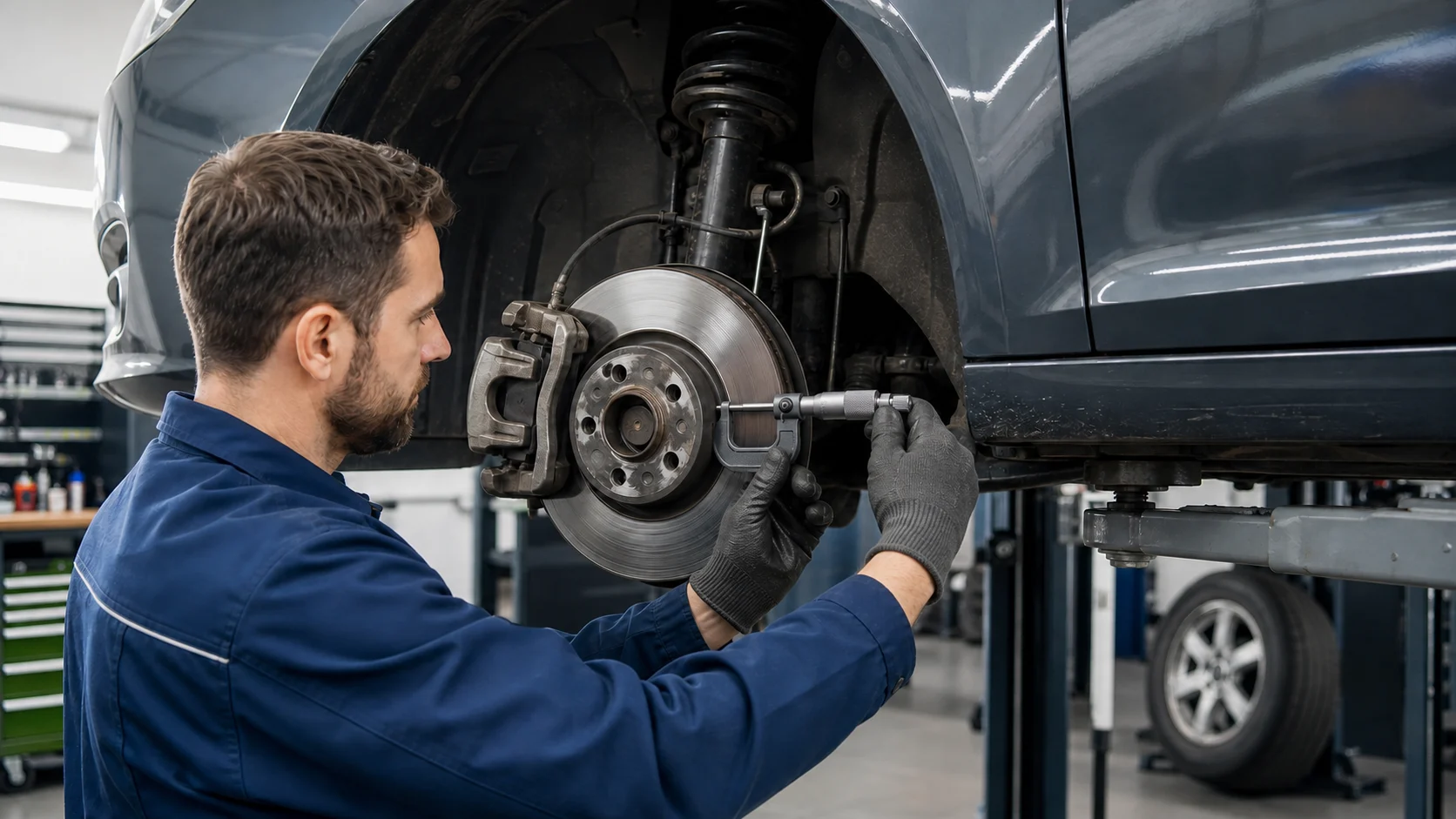
| Brake discs | Measure thickness at several positions; inspect surface and runout where needed | The marked or documented minimum thickness is component-specific. |
| Calipers and guides | Check free movement, boots, piston, and equal application | Sticking parts can cause one-sided wear and overheating. |
| Lines and hoses | Inspect for leaks, corrosion, cracking, and abrasion | Hydraulic loss can endanger braking. |
| Brake fluid | Check level, condition, and schedule; use an appropriate test where needed | Water absorption lowers boiling point and can promote corrosion. |
| Brake force | Brake tester, diagnostics, and a controlled road test where appropriate | Measures overall effect and side-to-side imbalance reproducibly. |
The TÜV NORD roadworthiness checklist includes visible lines, hoses, pads, discs, fluid condition, leaks, free movement, and even braking effect. Passing a periodic inspection does not replace diagnosis when a new symptom develops later.
Pads or discs: what actually needs replacement?
“Replace the brakes” can describe several different jobs. Worn pads do not automatically require new discs. A disc needs replacement when it is below its specified minimum thickness, is damaged, or has another condition that prevents safe continued use. New friction parts do not repair a defective caliper.
Friction components are normally replaced across an axle according to manufacturer instructions so the left and right sides have comparable conditions. After work, installation, free movement, fluid level, warnings, and braking effect require checks. New pads and discs may also need the bedding procedure specified by the manufacturer or component supplier.
Brake fluid is part of the system
Brake fluid transfers pedal force hydraulically. Common glycol-based fluids absorb water over time, which can lower the boiling point. ADAC and TÜV NORD commonly refer to replacement by about two years at the latest; the vehicle manufacturer’s schedule and required fluid remain decisive.
A low level may relate to pad wear, but it can also signal leakage. Do not merely top up and continue. Different fluid types must not be mixed without a clear vehicle-specific approval.
How much does brake repair cost?
An undated nationwide price chart would not be useful. Cost depends on the affected axle and whether pads, discs, a caliper, sensor, or fluid are required, as well as approved parts quality and labour time. Compare quotes only when their scope matches.
| Topic | Amount | Notes |
|---|---|---|
| front or rear axle identified | - | - |
| pads, discs, sensors, and fitting parts itemised | - | - |
| parts manufacturer or quality standard stated | - | - |
| labour, brake fluid, and disposal included | - | - |
| root-cause diagnosis and final test included | - | - |
| total price including applicable tax | - | - |
Store the invoice, mileage, and measured remaining values in the vehicle history. That can reveal whether wear was even or whether a caliper or guide later causes a repeated problem.
After repair: what should be checked?
Confirm that the invoice identifies the axle, parts, measurements, and final checks. The workshop should explain whether new friction components require bedding and which braking loads to avoid during that period. There is no single bedding routine for every product; follow the component supplier and workshop instructions.
Warning lights should clear according to the vehicle’s normal logic after a correct repair. Report new grinding, strong pulling, abnormal smell, or changed pedal feel immediately. A cautious function check in a safe environment cannot replace a brake tester, but it can reveal an obvious change early. Record the date and mileage so later wear remains traceable.
Practical driver checklist
Conclusion
Eight warning categories can indicate urgency, but they cannot replace measurement. A red brake warning, suddenly soft pedal, significant loss of braking, fluid leakage, smoke, or severe overheating requires safe stopping and professional help. A yellow wear warning, recurring squeal, or mild vibration calls for a prompt workshop visit when no critical symptom is present.
Do not rely on a universal mileage or pad-thickness rule. A qualified inspection considers pads, discs, calipers, hydraulics, fluid, warning systems, and measured brake force together before deciding which parts actually need replacement.
Frequently asked questions
When should I stop driving because of a brake problem?+
Stop safely and arrange roadside help for sudden braking loss, a very soft or sinking pedal, visible fluid leakage, smoke, severe overheating, or a red brake warning that remains after the parking brake is released.
Does squealing always mean the brake pads are worn out?+
No. Moisture, surface rust, dust, friction material, glazing, or a mechanical wear tab can cause noise. Persistent or increasing squeal and any combination with weaker braking or a warning should be inspected.
How long do brake pads last?+
There is no dependable universal mileage. Vehicle mass, brake design, driving style, traffic, terrain, towing, and other conditions affect wear. Measurement and the manufacturer limit are decisive.
Must brake discs always be replaced with the pads?+
Not automatically. Disc thickness, surface, runout, and the manufacturer limit determine whether continued use is appropriate. Damaged or undersized discs require replacement.
What does a red brake warning light mean?+
Depending on the car, it may indicate the parking brake, low brake fluid, worn pads, or a system fault. If it remains after the parking brake is released, interrupt the journey, check the manual, and use roadside help when uncertain.
Is brake-pedal pulsation always a fault?+
Pulsation during ABS operation in a hard stop can be normal. Recurring judder during ordinary braking can have several causes and should be measured together with the discs, wheels, tyres, and suspension.
Fahrnex note
The calmest maintenance decisions usually come from keeping dates, receipts, and service history connected instead of scattered.
About this article
Fahrnex evidence check
Fact check & sources
The guide separates critical stop-driving symptoms from signs requiring a prompt workshop visit. It avoids universal mileage and pad-thickness limits and describes diagnosis of the complete braking system rather than assuming a parts replacement.
| Claim checked | Evidence basis | Editorial conclusion |
|---|---|---|
| Red brake warning | ADAC brake-fluid and warning-light guidance | Interrupt the journey and use vehicle-specific instructions or roadside help. |
| Yellow pad-wear indicator | ADAC warning-light guidance | Arrange a workshop appointment soon if no critical additional symptom exists. |
| Wear intervals | ADAC maintenance guidance | No universal mileage; use, measurement, and manufacturer limits matter. |
| Inspection scope | TÜV NORD checklist and DEKRA inspection information | Pads, discs, lines, hoses, fluid, leaks, and braking effect belong in a complete assessment. |
Editorial verification steps
- Used eight genuinely distinct warning categories
- Added stop-driving instructions for critical symptoms
- Separated red and yellow dashboard warnings
- Removed generic mileage and millimetre thresholds
- Presented possible causes without remote diagnosis
- Added professional inspection and documentation workflow
Editorially reviewed on 18 August 2026. Sources:
The editorial team checked official sources against the Fahrnex product methodology. This article is not a substitute for case-specific technical, legal or tax advice.