Buying a Used Car in Germany: Inspection, Test Drive and Document Checklist
A structured used-car checklist for Germany covering seller identity, VIN, documents, inspection, test drive, running costs and a defensible purchase decision.
By the Fahrnex Editorial Team · Reviewed by Umme Hanna Meskat
A clean-looking car and a persuasive advertisement are not enough to support an expensive purchase. A reliable assessment connects the seller, the vehicle identity, its records, its physical condition and the expected costs after handover. This guide gives English-speaking buyers in Germany a repeatable inspection process without pretending that a visual check replaces an independent technical assessment.
Quick answer
Before paying a deposit, match the VIN across the vehicle and documents, identify the contractual seller, review registration and inspection records, inspect the car in daylight, complete a cold-start test drive and calculate an immediate repair reserve. Pause the purchase if important information cannot be verified.
Keep the next vehicle deadline visible without scattered paperwork.
Fahrnex connects reminders, documents, and service history so inspections and maintenance are easier to plan before they become urgent.
Create a free accountKey takeaways
Verify the seller, vehicle and VIN
Ask who will be named as the seller in the contract and compare that identity with the available records. Locate the VIN on the vehicle and compare it character by character with the registration documents. Differences, damaged identification areas or pressure to skip this step justify stopping the process.
Review the documents
Registration Certificate Parts I and II, the latest HU report, invoices and a service history help reconstruct the vehicle story. Missing paperwork is not automatically proof of a defect, but it reduces what can be verified and should affect the risk assessment.
Registration documents
HU report and follow-up evidence
Service book or digital service records
Invoices for major repairs and replacement parts
Inspect the car in daylight
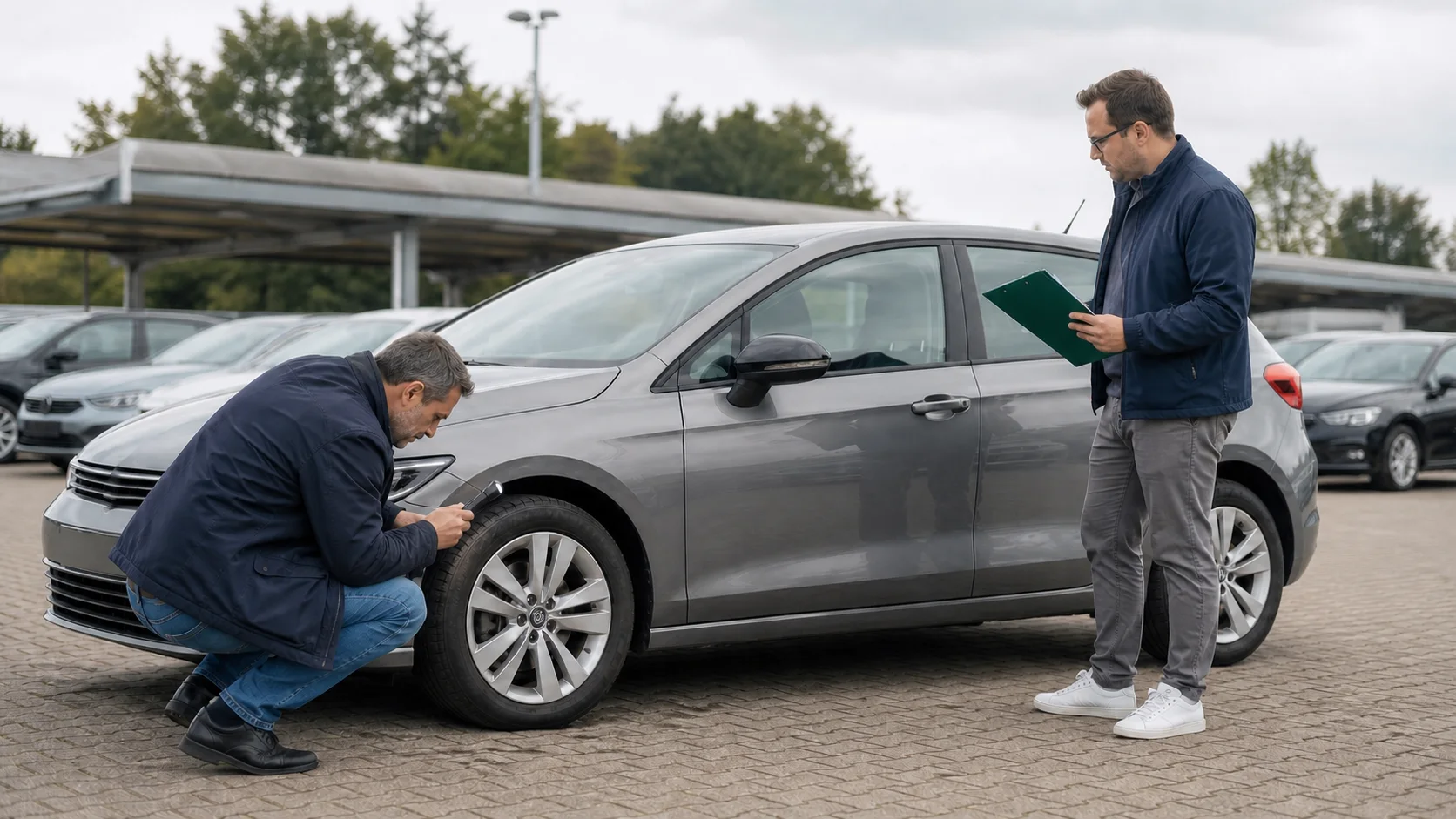
Walk around the car before it is moved. Compare panel gaps, paint tone, glass markings and tyre condition. Inside, test every seat belt, window, lock, light, climate function and driver-assistance feature. Under the bonnet, look for obvious leaks or improvised wiring without touching hot or moving components.
Run a reproducible test drive
Start with a genuinely cold engine where possible. Use urban streets and a faster road, while remaining within traffic rules. Observe starting behaviour, clutch or transmission response, steering, braking, suspension noise and temperature. A short drive around the block is insufficient for an informed decision.
Calculate the first twelve months
The asking price is only the first number. Build a twelve-month estimate for registration, insurance, vehicle tax, tyres, overdue servicing and likely repairs. A cheaper car with weak records can be more expensive than a better-documented alternative.
| Topic | Amount | Notes |
|---|---|---|
| Purchase and registration | - | - |
| Insurance and tax | - | - |
| Immediate maintenance | - | - |
| Tyres and defect reserve | - | - |
Know when to walk away
Do not let travel time or a deposit create pressure to complete the deal. Refusal of a proper test drive, unexplained VIN inconsistencies, unresolved warning lights, unclear ownership or a request for payment outside the written contract are reasons to pause and obtain professional advice.
Common mistakes to avoid
A practical Fahrnex workflow
A repeatable process is more reliable than memory or scattered notes:
Conclusion
A good used-car decision is traceable: you can explain what was checked, which evidence was available, what remains uncertain and how the price reflects that uncertainty. When the evidence is incomplete, an independent pre-purchase inspection is usually cheaper than discovering a major defect later.
Prepare before contacting the seller
A useful inspection begins before the appointment. Save the complete advertisement, including photographs, equipment claims, mileage and seller wording. Ask whether the vehicle will be cold when you arrive, whether a meaningful test drive is possible and which original documents can be inspected. Request the VIN only through a sensible and secure channel; do not publish it or send identity documents unnecessarily. Compare the advertisement with typical specifications for the stated model, engine and registration year. Differences may be innocent data-entry mistakes, but they should be resolved before travel.
Create a short list of deal-breaking requirements and a separate list of negotiable preferences. This prevents an attractive presentation from changing the decision criteria during the visit. Bring a torch, tyre-depth gauge, clean cloth, phone charger and printed checklist. If you lack technical confidence, arrange an independent inspection in advance rather than asking for it only after doubts arise.
Read the vehicle history as a timeline
Documents are most useful when placed in chronological order. Begin with registration dates, recorded holders and HU reports, then add service entries and repair invoices. Mileage should progress plausibly through the timeline. A missing period is not automatic proof of manipulation, but it creates uncertainty that needs an explanation. Look for major work such as timing-belt replacement, transmission service, accident repair, brake renewal or high-voltage battery diagnostics where relevant.
Check whether invoice descriptions identify the vehicle and whether dates, mileage and parts make sense together. A stamped service book without supporting detail may be less informative than a coherent collection of invoices. For digital service histories, ask how the record can be viewed and transferred. Never treat a seller-created spreadsheet as independent proof by itself.
Inspect bodywork without pretending to be an expert
Start several metres away and compare reflections along both sides. Uneven panel gaps, overspray on rubber, paint edges inside door openings or different shades can indicate earlier repair. Repairs are not automatically unacceptable; the important questions are what happened, who repaired it and whether the work is documented. Examine lower doors, wheel arches, jacking points and the visible underside for corrosion or fresh coating that hides rather than explains the condition.
Check every window and lamp for cracks, condensation or inconsistent date markings. Inspect tyres on both outer and visible inner edges. Uneven wear may relate to alignment, suspension, pressure or driving history. Confirm that tyre size, load and speed ratings are appropriate for the vehicle and that a usable seasonal set is actually included when promised.
Use the cold start to establish a baseline
A warm engine can hide starting problems, smoke and unusual initial noises. Before starting, observe whether the bonnet or engine is already warm. Switch on the ignition and confirm that relevant warning lamps illuminate for their self-check and then extinguish as expected. Listen during starting and idle, but do not place hands near belts, fans or hot components. Persistent warning messages, strong fuel smells, irregular idle or unexplained smoke need professional diagnosis.
For an electric car, check charging equipment, displayed warnings, available battery information and whether the advertised cables are present. A dashboard range estimate is not a battery-health certificate because temperature and recent driving strongly influence it. Request suitable diagnostic evidence if battery condition materially affects the purchase.
Structure the test drive into phases
Agree on insurance and driving permission before moving. Begin at low speed to assess clutch engagement, steering assistance, parking sensors and basic braking. Continue over an ordinary uneven road to listen for suspension noise, then use a suitable faster road to check tracking, vibration, wind noise and power delivery. Test reverse gear and a safe parking manoeuvre. Never perform emergency manoeuvres or illegal speed tests.
PhaseObserveRecordCold startStarting, idle, smoke, warningsConditions and durationUrban driveClutch, gearbox, steering, brakesNoise and repeatable symptomsFaster roadTracking, vibration, temperatureSpeed range where issue appearsAfter driveLeaks, smells, warning messagesPhotos and seller explanation
Turn defects into a decision, not just a discount
For every finding, classify whether it is cosmetic, maintenance-related, safety-relevant or still unknown. Obtain a realistic repair estimate before negotiating when the amount could change the purchase decision. A discount does not remove the operational risk of worn tyres, unresolved warning lights or uncertain timing-belt history. Include the inconvenience of appointments and unavailable parts, not only the invoice amount.
Use three totals: the purchase payment, unavoidable immediate costs and a twelve-month risk reserve. Compare those totals with at least one alternative vehicle. If the seller will not allow enough time for verification, the correct decision may be to leave rather than to price unknown risk.
Complete a controlled handover
The contract should identify the parties and vehicle, record the mileage statement, price, known defects, accident information, included equipment, keys and documents, payment method and exact handover time. Read every handwritten addition. Do not sign blank spaces or rely on verbal promises that should form part of the agreement. Confirm how registration, deregistration, transport and insurance responsibility will be handled.
At handover, photograph the mileage and condition with permission, count keys and documents, and obtain a receipt. After purchase, create a vehicle file containing the advertisement, contract, inspection notes, registration records, insurance and first maintenance plan. This evidence supports future repairs, claims and resale decisions.
Frequently asked questions
Which documents should I check when buying a used car in Germany?+
Check the registration documents, the latest HU report, available service records, repair invoices and the written sales contract. Confirm that the VIN is consistent across the vehicle and documents.
Does a valid TÜV inspection guarantee that a used car is problem-free?+
No. The HU assesses defined roadworthiness points at the inspection date; it is not a warranty covering the vehicle's entire mechanical and commercial condition.
Should I arrange an independent inspection?+
It is sensible when the car is valuable, its history is incomplete, you lack technical experience or the inspection reveals inconsistencies.
What should be written into the purchase contract?+
Record the parties, vehicle identity, mileage statement, price, known defects, accident disclosures, included keys and accessories, handover time and agreed payment method.
Fahrnex note
The calmest maintenance decisions usually come from keeping dates, receipts, and service history connected instead of scattered.
About this article
Fahrnex evidence check
Fact check & sources
The checklist separates identity, legal documents, physical inspection and purchase-cost decisions. It was checked against German motoring, consumer-contract and registration guidance.
| Claim checked | Evidence basis | Editorial result |
|---|---|---|
| Vehicle and document checks | ADAC used-car guidance | Included with a VIN-first inspection process |
| Contract caution | Verbraucherzentrale consumer guidance | Defects and agreements must be recorded clearly |
| Post-purchase registration | Federal Portal | Registration requirements are treated separately from condition checks |
Review checklist
- Open each source and confirm it remains current.
- Check that examples are labelled and not presented as universal prices.
- Keep the distinction between HU status and a full condition guarantee.
Editorially reviewed on 17 August 2026. Sources:
The editorial team checked official sources against the Fahrnex product methodology. This article is not a substitute for case-specific technical, legal or tax advice.