How to Read a Volkswagen VIN: VW, Audi, Škoda and SEAT Explained
WVW, ZZZ, a two-character type code and a model-year letter: how to read a Volkswagen Group VIN character by character, and what a free VW VIN lookup can and cannot tell you.
By the Fahrnex Editorial Team · Reviewed by Umme Hanna Meskat
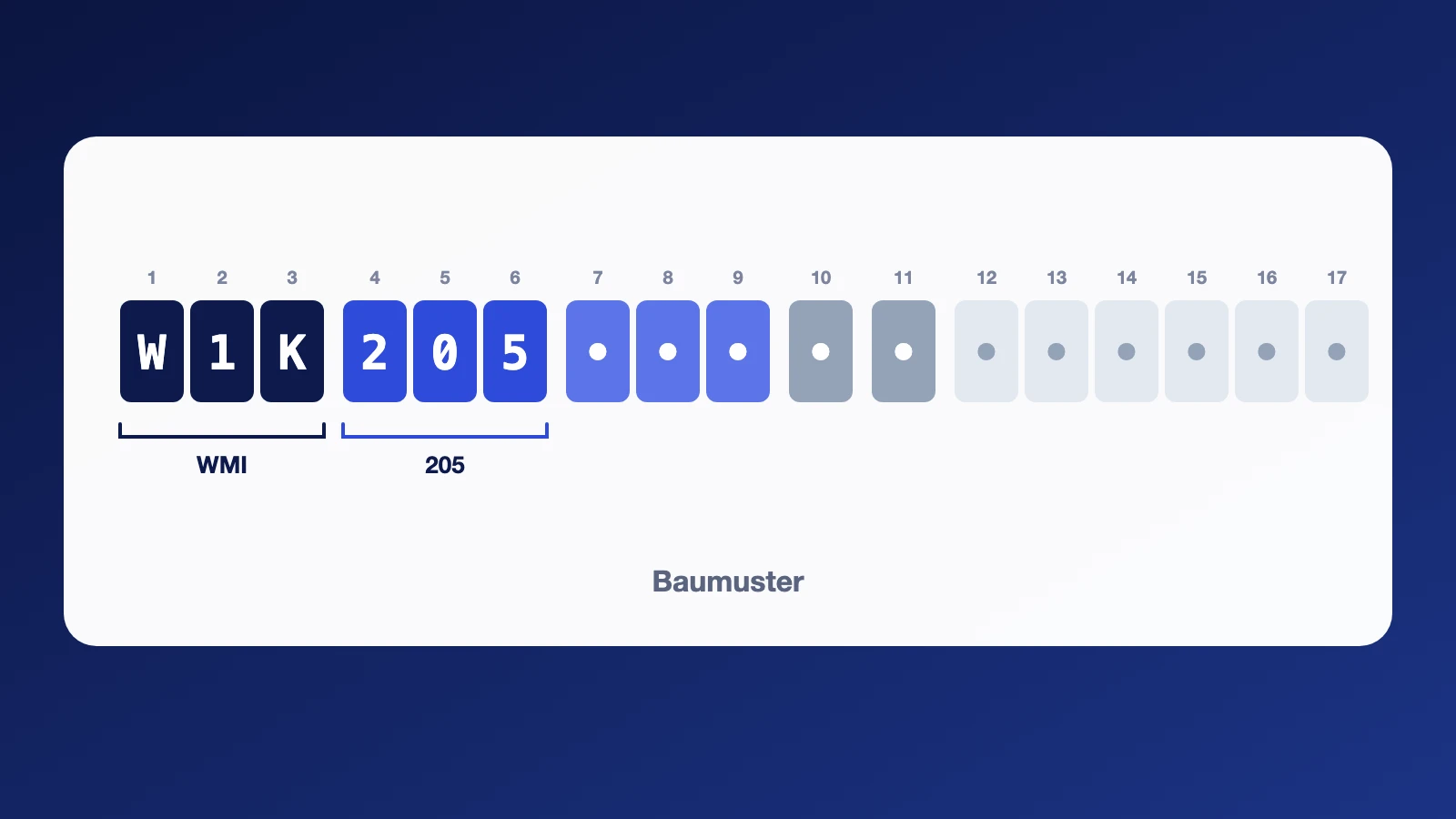
A Volkswagen VIN looks cryptic, but most Volkswagen Group cars sold in Europe follow the same readable pattern: a three-letter manufacturer code, the filler ZZZ, a two-character type code, the model year and the plant. Once you know the pattern you can check in seconds whether a listing really describes the car you are looking at. To decode a VIN automatically, use the free VW VIN decoder.
The quick version
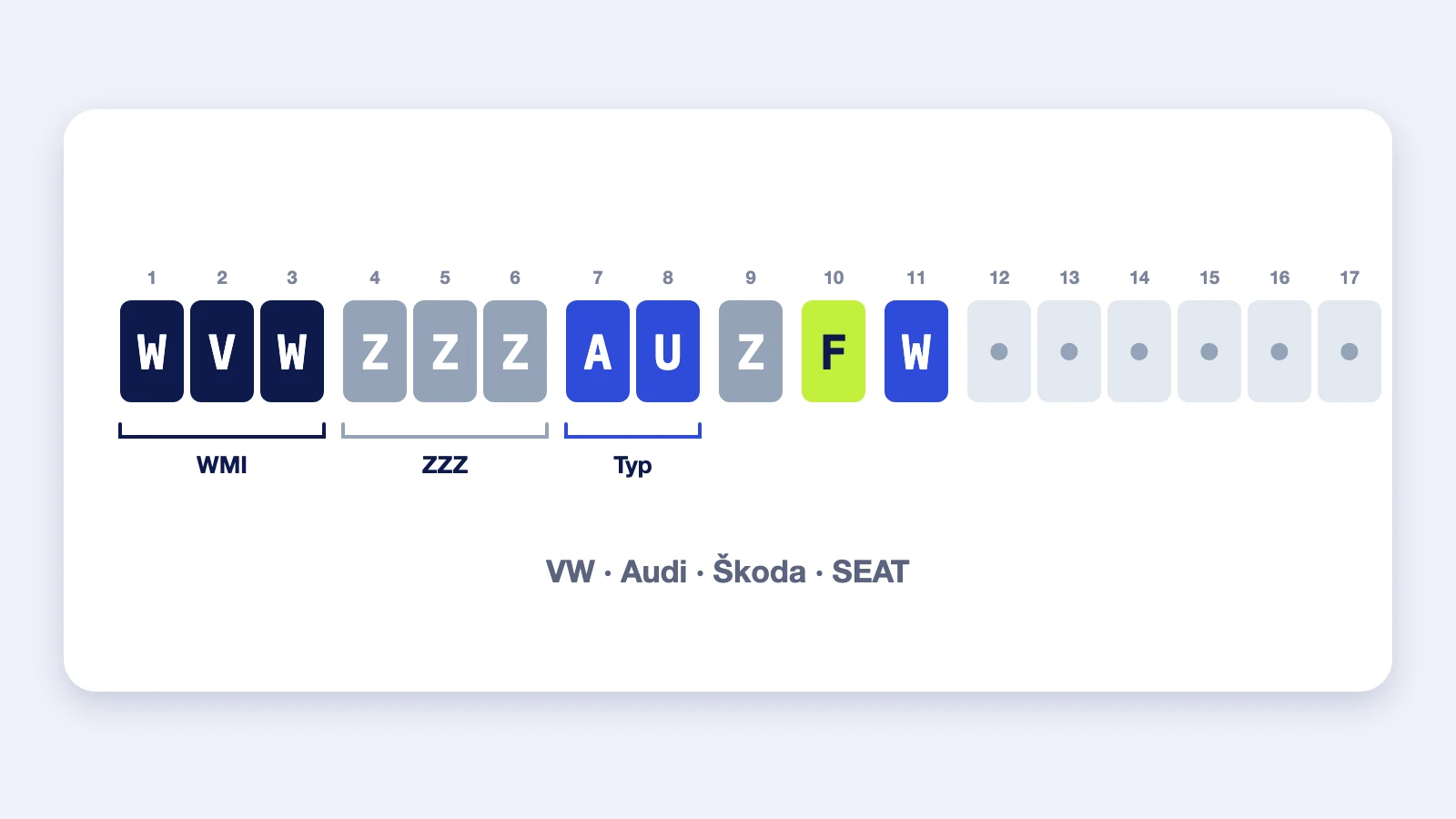
Take this typical European VW VIN, with the serial number hidden: WVW ZZZ AU Z F W ●●●●●●.
| Positions | Example | Meaning |
|---|---|---|
| 1–3 | WVW | World Manufacturer Identifier (WMI): Volkswagen passenger car |
| 4–6 | ZZZ | Filler used on many European Volkswagen Group VINs |
| 7–8 | AU | Type code: here the seventh-generation Golf |
| 9 | Z | Filler on European cars (no check digit) |
| 10 | F | Model year: F = 2015 |
| 11 | W | Assembly plant: W = Wolfsburg |
| 12–17 | ●●●●●● | Serial number of the individual car |
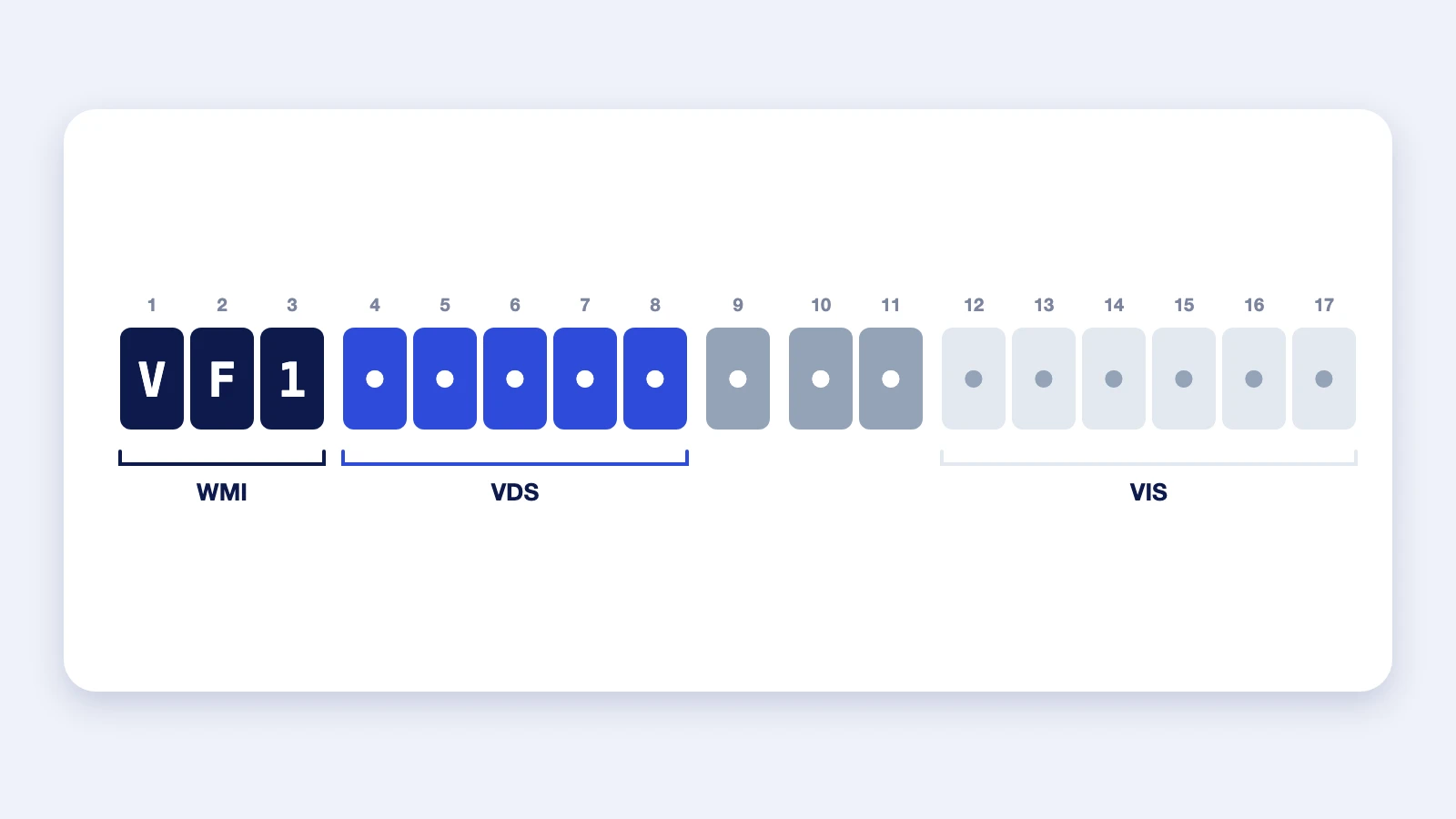
Every modern VIN follows the same 17-character skeleton. In North America, 49 CFR Part 565 also makes position 9 a calculated check digit and position 10 the model year. In Europe, Regulation (EU) No 19/2011 requires a VIN but not those two conventions, so European manufacturers use positions 4–11 in their own ways. That is why a European VIN cannot always be read with a US rule of thumb.
Keep the next vehicle deadline visible without scattered paperwork.
Fahrnex connects reminders, documents, and service history so inspections and maintenance are easier to plan before they become urgent.
Create a free accountPositions 1–3: which brand built the car
The first three characters are the World Manufacturer Identifier. The most common Volkswagen Group codes in Germany are:
| WMI | Brand | Notes |
|---|---|---|
| WVW | Volkswagen | Passenger cars |
| WVG | Volkswagen | Many SUVs, such as the Tiguan and Touareg |
| WV1, WV2 | Volkswagen Commercial Vehicles | Vans and light commercial vehicles |
| WAU | Audi | Passenger cars |
| TMB | Škoda | Built in the Czech Republic |
| VSS | SEAT | Built in Spain |
| 3VW, 9BW, 1VW | Volkswagen | Built in Mexico, Brazil and the USA |
The WMI identifies the manufacturer and region that assigned the VIN. It is not always the country of final assembly, which is why position 11 matters too.
Positions 4–9: ZZZ and the type code
On many Volkswagen, Audi and SEAT cars built for Europe, positions 4–6 are simply ZZZ, and position 9 is another Z. These are fillers: European rules do not require a check digit, so Volkswagen leaves the positions unused.
Positions 7–8 carry the two-character type code that Volkswagen also uses in parts catalogues and workshop literature. A few well-known examples:
| Type code | Model | Typical VIN start |
|---|---|---|
| AU | VW Golf, seventh generation | WVWZZZAU… |
| CD | VW Golf, eighth generation | WVWZZZCD… |
| 8V | Audi A3, third generation | WAUZZZ8V… |
| 5F | SEAT León, third generation | VSSZZZ5F… |
So if a listing advertises a “Golf 8” but the VIN starts with WVWZZZAU, the car is a Golf 7. Our Golf VIN page and Passat VIN page cover the two best-selling models in more detail.
Škoda is the exception. Škoda VINs (TMB) use positions 4–8 differently and do not follow the ZZZ pattern, so read them with the Škoda VIN decoder instead of this table.
Position 10: the model year
Volkswagen Group VINs normally encode the model year in position 10, using the standard letter and digit sequence (the letters I, O, Q, U and Z are never used):
| Code | Model year | Code | Model year | Code | Model year |
|---|---|---|---|---|---|
| A | 2010 | G | 2016 | N | 2022 |
| B | 2011 | H | 2017 | P | 2023 |
| C | 2012 | J | 2018 | R | 2024 |
| D | 2013 | K | 2019 | S | 2025 |
| E | 2014 | L | 2020 | T | 2026 |
| F | 2015 | M | 2021 | V | 2027 |
The model year is not always the year of production: a car built in autumn can already carry the next model year. For the date the car was first registered, check field B of the German registration certificate (Zulassungsbescheinigung Teil I).
Position 11: the plant, and 12–17: the serial number
Position 11 identifies the assembly plant. W stands for Wolfsburg; other letters are used for other plants, and the same letter can mean different plants in different model families, so treat plant codes as a cross-check rather than proof. Positions 12–17 are the serial number that makes the VIN unique.
Where to find the VIN on a VW, Audi, Škoda or SEAT
Compare at least two of these locations: they must match exactly. A mismatch is a reason to walk away from a purchase.
What a free VW VIN lookup can and cannot tell you
The Fahrnex decoder reads the manufacturer data published for a VIN in the official NHTSA vPIC dataset. For cars built for the European market this data is often incomplete, so some fields can stay empty. A decode confirms identity details; it does not show accident history, previous owners, mileage or whether a specific car has an open recall.
For a used-car purchase, combine the decode with the paperwork and a history report. Our guide to a free car history check in Germany explains which checks are free and which are not. Decoders for the other group brands: Audi, Škoda and SEAT.
Frequently asked questions
What does ZZZ mean in a VW VIN?+
ZZZ is a filler in positions 4–6 used on many European Volkswagen, Audi and SEAT VINs. European rules do not require these positions to carry a check value, so Volkswagen fills them with Z.
How do I tell the VW model from the VIN?+
Look at positions 7–8, the type code. AU, for example, is the seventh-generation Golf and CD the eighth generation. A free decoder shows the model where the manufacturer has published the data.
Which letter is the model year in a VW VIN?+
Position 10. F is 2015, L is 2020, R is 2024 and T is 2026. The model year can differ from the production year.
Fahrnex note
The calmest maintenance decisions usually come from keeping dates, receipts, and service history connected instead of scattered.
Share this article
About this article
Fahrnex evidence check
How we checked this VIN guide
The structure follows the VIN standard and the EU and US rules on VIN content. Brand codes and examples were cross-checked against published Volkswagen Group VINs and the Fahrnex decoder data.
| Point | Source | Note |
|---|---|---|
| Check digit and model year required in North America | 49 CFR Part 565 | Not required in the EU, hence the Z fillers. |
| VIN requirement in the EU | Regulation (EU) No 19/2011 | Defines the VIN plate and marking, not the content of positions 4–11. |
| Decoder data | NHTSA vPIC (used by Fahrnex) | European-market VINs often return fewer fields. |
Before you trust a VW listing
- Compare the VIN in two places on the car
- Check the type code against the advertised model
- Read the model year in position 10
- Match the VIN with field E of the registration
Editorially reviewed on 10 November 2026. Sources:
The editorial team checked official sources against the Fahrnex product methodology. This article is not a substitute for case-specific technical, legal or tax advice.