Digital Mileage Log in Germany: Guide for Drivers and Fleets
Learn which details a German digital mileage log needs, how corrections should remain traceable, and what drivers and small fleets should check for tax, privacy, and daily use.
By the Fahrnex Editorial Team · Reviewed by Umme Hanna Meskat
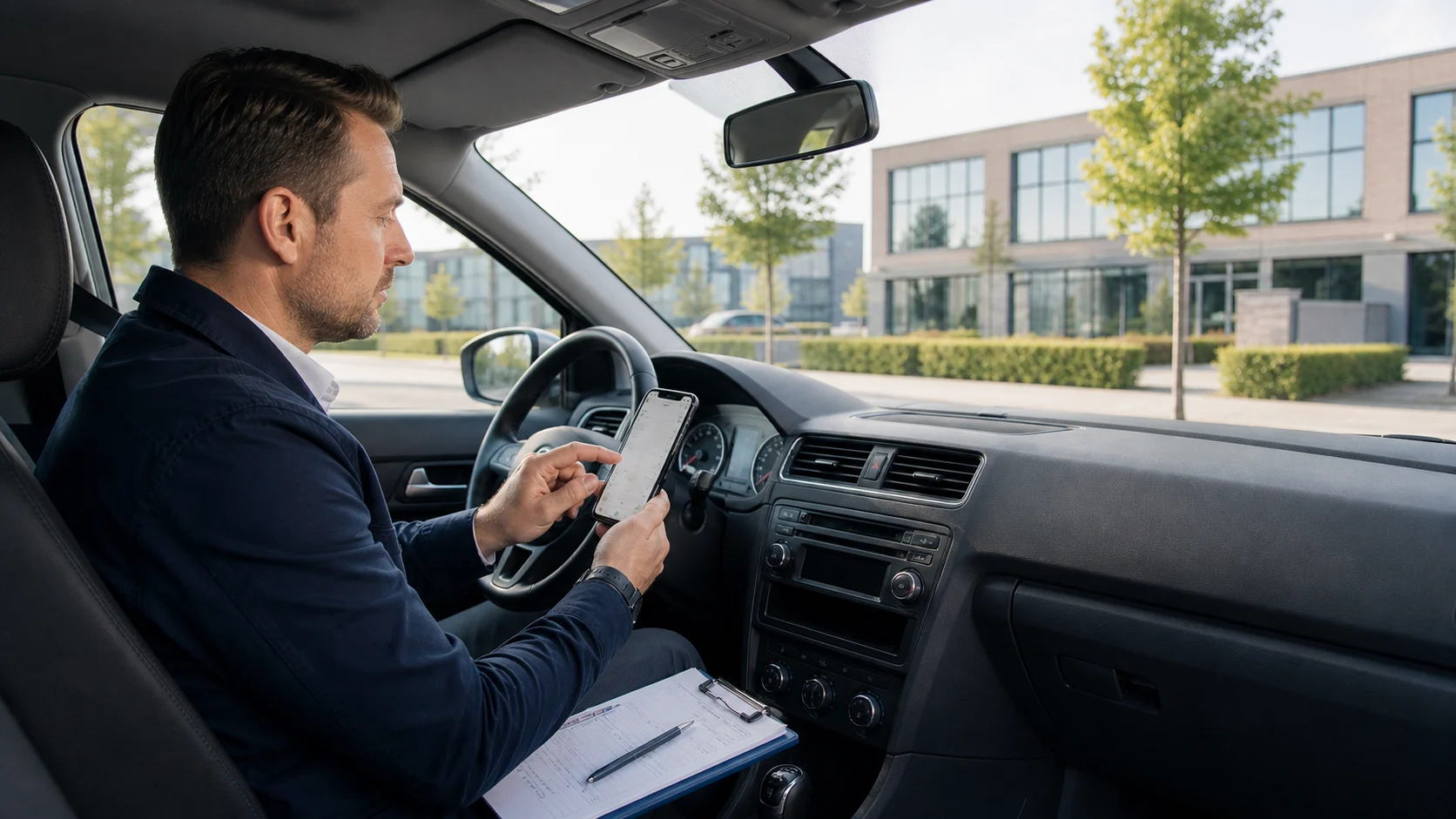
A digital mileage log can organise business, private, and commuting journeys without a notebook in the glovebox. Drivers spend less time reconstructing trips, while small fleets gain a consistent basis for reviewing vehicle use. If the record will be used for German tax purposes, however, not every app or editable spreadsheet is sufficient. The entries must be complete, timely, and verifiable.
This guide explains the practical principles and key German tax requirements in plain English. It is general information, not individual tax or legal advice. The responsible tax authority ultimately assesses whether a specific mileage log and the way it was maintained satisfy the rules.
Quick answer: what makes a digital mileage log useful?
A dependable mileage log records every journey in sequence, preserves odometer readings, and distinguishes business journeys, commuting between home and a first workplace or business premises, and private travel. Entries should be completed promptly. Later changes must either be prevented or remain visible through a reliable audit history.
Keep the next vehicle deadline visible without scattered paperwork.
Fahrnex connects reminders, documents, and service history so inspections and maintenance are easier to plan before they become urgent.
Create a free accountWhen is a mileage log relevant for German tax?
It is inaccurate to say that German law requires a formal mileage log for every deductible business journey. An ordnungsgemäßes Fahrtenbuch is particularly relevant when the private use of a business vehicle or an employer-provided company car is to be valued using attributable actual costs instead of a lump-sum taxable benefit. The central basis includes section 6(1)(4) of the German Income Tax Act, together with section 8 for employees.
The available method depends on factors such as ownership, the right to private use, the share of business use, and the person’s tax situation. The 1% method is therefore not an automatic universal result whenever a mileage log is missing or rejected. Recording one reimbursable business journey and calculating the private-use share of a business vehicle are also different questions.
What information belongs in a compliant German log?
The Federal Ministry of Finance’s official wage-tax guidance summarises the relevant court decisions: a mileage log must be maintained promptly, in a closed form, and as a continuous record. The required detail differs by journey type.
| Journey type | Typical required information | Practical example |
|---|---|---|
| Business or professional journey | Date, odometer, destination, purpose, and customer or business partner; necessary route deviations where relevant | 18 Aug 2026, 42,180–42,236 km, Cologne, project meeting with Example GmbH |
| Private journey | Distance or continuous odometer figures and classification as private | 42,236–42,251 km, private |
| Home–first workplace or business premises | Short, unambiguous classification and continuous odometer | 42,251–42,270 km, home–first workplace |
A destination such as “customer,” “field work,” or only a street name may be too vague. The customer, business partner, or specific professional activity should make the journey understandable from the mileage log itself. If one business trip contains several customer stops, their order should remain traceable.
Digital does not automatically mean tax-ready
A digital process can be easier than paper, but it must serve the same evidential purpose. An ordinary spreadsheet is freely editable and is therefore problematic as the sole tax mileage log. The German Federal Fiscal Court has stated that later changes must either be technically excluded or documented and disclosed within the file in terms of their extent.
Questions to ask about mileage-log software
A GPS track alone does not answer these questions. It may capture route and time, but it does not automatically know the correct tax purpose, customer, or journey category. Those details still need timely human review.
How promptly should journeys be classified?
There is no universal number of minutes or hours stated for every entry. In practice, “promptly” means the record still has a reliable connection to the journey and was not reconstructed weeks later from calendars, messages, and memory. A sensible routine is to review the journey after the vehicle has been parked safely or by the end of the working day.
Automatically detected journeys should not remain unreviewed for long periods. A small fleet can use an after-trip reminder and a daily or weekly completeness check. That routine does not guarantee correct content, but it reduces forgotten classifications.
A reliable daily workflow
Worked example: document three journeys clearly
The following example is fictional and demonstrates structure only. Whether a record is sufficient depends on the actual facts and use.
| Time | Odometer | Category | Destination and purpose |
|---|---|---|---|
| 08:10–08:55 | 28,410–28,452 km | business | Bonn, proposal meeting with Example AG |
| 09:20–09:36 | 28,452–28,463 km | business | Siegburg, collect project documents from Sample Office |
| 18:05–18:24 | 28,463–28,479 km | private | Private journey |
The odometer readings connect, the business reasons are specific, and the private journey is classified without recording unnecessary private location details. Any missing kilometres between entries should be investigated promptly.
Does every small error invalidate the log?
No. The official guidance notes that minor deficiencies do not necessarily invalidate the complete mileage log when the records remain plausible overall. This is not permission for recurring gaps, vague purposes, or months reconstructed later. The extent, frequency, and significance of the errors—and whether the full record can still be checked—matter.
Software can help by highlighting missing kilometres, overlapping journeys, unusually late classifications, or unexplained changes. It cannot make the final tax assessment; that remains with the relevant German tax authority.
Paper, spreadsheet, or specialist software?
| Method | Advantages | Risks and limits |
|---|---|---|
| Bound paper logbook | Visible, closed sequence; no technical dependency | Manual work, loss risk, difficult analysis |
| Ordinary spreadsheet | Flexible and easy to export | Later edits are usually not sufficiently traceable; risky as the sole tax evidence |
| Specialist mileage-log software | May provide automatic trip detection, required fields, edit history, and export | The actual implementation and user process still require review |
| General vehicle-management platform | Connects costs, documents, maintenance, and vehicle use | Not automatically a tax-compliant mileage log |
Connect journeys with vehicle expenses
Journey records and cost records answer different questions. A mileage log documents use and journey categories; an expense history covers fuel, maintenance, repairs, insurance, and other spending. Together they can support figures such as cost per kilometre or comparisons between vehicles. Our guide How to Track Fuel, Maintenance, and Repair Costs explains the expense structure.
Fahrnex can bring together vehicle costs, documents, reminders, and service history. Those functions should not be confused with a promise that every journey stored in a general platform automatically forms a compliant German tax mileage log. Before tax use, check edit history, closed presentation, exports, and the actual recording process.
Privacy for drivers and fleets
Journey data may reveal locations, working times, and private movements. Before introducing a system, an organisation should define what data is needed, why it is processed, who can access it, and when it will be deleted. Drivers should receive clear information. Continuous location tracking is not automatically necessary simply because a digital mileage log is used.
Useful safeguards include role-based access, separating private detail from business evidence, protected exports, and documented responsibilities. Employers considering GPS monitoring or extensive employee travel analysis should obtain appropriate German privacy advice and involve employee representation where required.
Checklist before the first live month
Quality control for a small fleet
With several drivers, sound software settings are not enough. The organisation also needs a consistent process with clear roles: drivers record and classify journeys, a named reviewer checks completeness and unusual entries, and only a limited authorised group manages exports and system settings. A reviewer should not silently rewrite a driver’s entry, because that can make responsibility and edit history unclear.
A monthly sample review can ask:
The review should record what was checked and how discrepancies were resolved. It should not create retrospective “perfection” by inventing details that have no reliable evidence. Where a journey genuinely cannot be reconstructed, a visible uncertainty is more honest and auditable than fabricated precision.
Move safely from paper or spreadsheets to digital
Changing systems in the middle of a reporting period can create new breaks. Record the final confirmed odometer, migration date, and storage location of the previous log. Start the new system with a controlled opening figure and retain old records in their original form. Avoid imports that obscure when an entry was created or which original source it came from.
Before relying on the new system alone, run a short test using real journeys that are also independently checked. Test mobile capture, offline behaviour, driver changes, correction history, and exports. Where the tax treatment is material, discuss the transition with a German tax adviser before ending the previous process.
Conclusion
A digital mileage log can save drivers and fleets significant work when it records more than route traces. For German tax purposes, the continuous form, specific business information, timely classification, and visible edit history are especially important.
Begin with a test period, inspect the export and correction history, and clarify your tax position early. You can then connect journey data with expenses and maintenance while avoiding the misleading assumption that any general vehicle-management record is automatically a tax-compliant mileage log.
Frequently asked questions
Can a digital mileage log be used for German tax purposes?+
It can be used in principle if it is maintained promptly, continuously, and in a closed form. Later changes must be prevented or traceably documented. The tax authority assesses the actual record and process in the individual case.
Is an Excel spreadsheet sufficient as a German tax mileage log?+
An ordinary freely editable spreadsheet is problematic because changes are usually not documented within the file as required. It can support internal planning but should not be assumed to qualify as the sole tax mileage log without professional review.
What details are needed for a business journey?+
Typical details include the date, continuous odometer readings, destination, specific business purpose, and customer or business partner. Detours and several stops should remain understandable.
Must a private journey include its exact destination?+
For the German tax mileage-log method, private journeys generally need the corresponding distance or odometer figures and classification as private. Unnecessary private location detail should be avoided.
Does every small error invalidate a German mileage log?+
Not necessarily. Minor deficiencies may be acceptable where the complete record remains plausible. Repeated gaps, vague business reasons, and extensive reconstruction after the event remain risky.
Is Fahrnex automatically a tax-compliant German mileage log?+
A general vehicle-management platform is not automatically a compliant tax mileage log. The specific edit history, closed presentation, exports, and actual recording process must be checked against the applicable requirements.
Fahrnex note
The calmest maintenance decisions usually come from keeping dates, receipts, and service history connected instead of scattered.
About this article
Fahrnex evidence check
Fact check & sources
Tax statements are limited to their relevant context. The guide distinguishes the German mileage-log valuation method from ordinary travel documentation and from general vehicle-management software, while making the tax authority’s case-by-case assessment explicit.
| Claim checked | Evidence basis | Editorial conclusion |
|---|---|---|
| Mileage-log method for private vehicle use | Sections 6(1)(4) and 8 of the German Income Tax Act | A formal mileage log is an evidence method in defined tax cases, not a universal requirement for every business trip. |
| Prompt and closed record | Official BMF wage-tax guidance citing Federal Fiscal Court decisions | The guide explains chronological continuity and specific business-journey details. |
| Electronic changes | German Federal Fiscal Court case law | Later edits must be prevented technically or disclosed within the record. |
| Effect of minor errors | Official BMF guidance citing the judgment of 10 April 2008 | Minor errors do not automatically invalidate an otherwise plausible record. |
Editorial verification steps
- Removed the claim that every deductible journey legally requires a mileage log
- Did not present the 1% method as a universal automatic consequence
- Separated required details by journey type
- Explained edit-history and export requirements
- Avoided marketing Fahrnex as automatically tax-compliant
- Added German tax and privacy limitations
Editorially reviewed on 18 August 2026. Sources:
The editorial team checked official sources against the Fahrnex product methodology. This article is not a substitute for case-specific technical, legal or tax advice.