How to Track Fuel, Maintenance, and Repair Costs
A consistent vehicle-expense record reveals what your car costs to run. Learn the fields, categories, formulas, and monthly routine that turn receipts into useful decisions.
By the Fahrnex Editorial Team · Reviewed by Umme Hanna Meskat
A fuel receipt in the glovebox, a workshop invoice buried in email, and an oil change remembered only approximately: this is how gaps appear in a vehicle-cost history. Recording fuel, maintenance, and repair expenses in one consistent format does more than produce a monthly total. It can reveal changes in fuel use, recurring maintenance needs, and a pattern of unplanned repairs as a vehicle ages.

This practical guide is for private vehicle owners and small fleets. It explains which details are worth recording, how to calculate useful indicators, and how to turn individual receipts into a reliable history. It does not provide tax advice; businesses should confirm retention and deductibility requirements with a qualified adviser.
Quick answer: the five-step vehicle-cost workflow
A useful system does not need to be complicated. It needs to capture every expense promptly and apply the same categories each time.
| Topic | Amount | Notes |
|---|---|---|
| Classify the expense | fuel or charging, scheduled maintenance, repair, wear item, or another vehicle cost. | - |
| Record the date and odometer | these make period and mileage comparisons possible. | - |
| Describe the purchase or work | write “inspection, oil and filter,” not simply “garage.” | - |
| Attach the evidence | keep the receipt or invoice under a clear file name. | - |
| Review once a month | fill gaps, explain unusual figures, and schedule the next due item. | - |
Download the free vehicle-cost CSV template. It contains the fields recommended in this guide and opens in Excel, Numbers, or another spreadsheet application. The example row can be deleted before use.
Keep the next vehicle deadline visible without scattered paperwork.
Fahrnex connects reminders, documents, and service history so inspections and maintenance are easier to plan before they become urgent.
Create a free accountWhich vehicle expenses belong in the record?
Fuel, maintenance, and repairs are only part of the total cost of owning a car. A purchase or replacement decision should also consider fixed costs and depreciation. The ADAC overview of car costs separates operating costs, fixed costs, workshop and tyre costs, and depreciation. For day-to-day records, the following structure is practical:
| Category | Typical examples | Why keep it separate? |
|---|---|---|
| Fuel or charging | Petrol, diesel, LPG, public charging, home charging | Shows energy use, price, and cost per kilometre. |
| Scheduled maintenance | Inspection, oil, filters, brake fluid, spark plugs | Makes recurring work and future due dates visible. |
| Repairs | Failed parts, accident repair, diagnosis, recovery | Highlights unplanned costs and recurring faults. |
| Wear items | Brakes, tyres, wiper blades, starter battery | Supports replacement planning by mileage and age. |
| Fixed costs | Insurance, vehicle tax, parking, roadworthiness inspection | Completes the view beyond day-to-day running costs. |
| Depreciation and finance | Loss of value, loan interest, lease initial payment | Captures major costs that never appear on a workshop bill. |
Categories should not overlap. A new set of tyres is a wear cost rather than a repair. If a scheduled service also includes replacement of a failed sensor, split the invoice between maintenance and repair where the bill provides enough detail. This keeps later comparisons meaningful.
The essential fields for every expense
An amount without context is difficult to analyse later. Each record should contain at least the date, vehicle, odometer reading, category, description, and total amount. Additional fields depend on the type of expense.
| Field | Example | What it enables |
|---|---|---|
| Date | 18 August 2026 | Assigns the event to a reporting period. |
| Odometer | 45,210 km | Supports cost-per-kilometre and interval calculations. |
| Category | Maintenance | Prevents an unhelpful single total. |
| Description | Inspection, engine oil, and oil filter | Shows what work was actually performed. |
| Total amount | €289.40 | Feeds monthly, annual, and mileage-based totals. |
| Supplier and invoice number | Example Garage, INV-2026-184 | Helps with questions, warranties, and claims. |
| Next due point | August 2027 or 60,000 km | Connects cost history with maintenance planning. |
For several vehicles, use a stable identifier. Registration numbers can change, so an internal vehicle name or the final six characters of the VIN may be more practical. Full VINs and invoices contain sensitive information and should be kept only in protected systems.
How to track fuel cost and consumption correctly
For each refuelling event, record the date, odometer, fuel grade, litres, price per litre, total amount, and whether the tank was filled completely. Germany’s official market-price infrastructure is the Bundeskartellamt Market Transparency Unit for Fuels. Petrol stations report prices for Super E5, Super E10, and diesel, which are then distributed through authorised consumer information services.
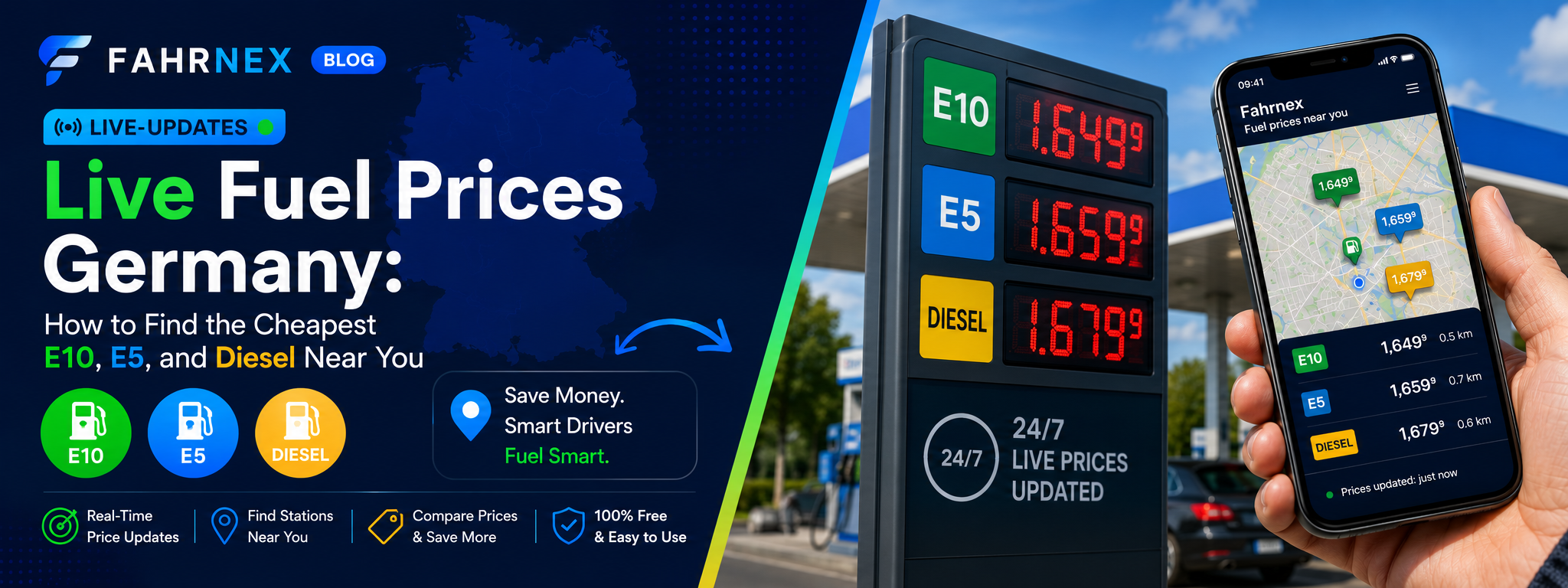
The Fahrnex Live Fuel Prices Germany tool helps compare current offers nearby, while the Fuel Cost Calculator supports route or monthly planning. Your own history is still necessary because it reflects your vehicle, routes, and driving pattern rather than a generic estimate.
Calculate consumption with the full-tank method
A single fill can produce a useful consumption figure only when both the previous and current entries represent full tanks. Use this formula:
Fuel consumption in l/100 km = litres added ÷ distance driven × 100
Example: a vehicle travels 684 kilometres between two complete fills and then takes 43.2 litres. The calculated consumption is 6.32 l/100 km. Pump shut-off behaviour, vehicle angle, and filling technique can distort one result, so an average across several full tanks is more reliable.
For an electric car, record charged kilowatt-hours and the billed cost. For cost analysis, the energy shown on the supplier’s invoice is usually more useful than the energy displayed as added to the battery because the billed amount includes charging losses. Vehicle and charging-provider figures may therefore differ.
Keep maintenance and repairs distinct
Maintenance is planned work intended to support function, safety, and value, such as a manufacturer-specified inspection or time- and mileage-based replacement. A repair addresses a particular defect or damage. Wear items sit between these categories: brake pads and tyres are expected, but their replacement timing depends heavily on condition and use.
Summarise workshop invoices in plain, specific language. Instead of entering only “service, €720,” separate labour, scheduled work, parts, and additional repairs when the invoice allows it. Keep the original document as evidence; the summary exists to make analysis easier, not to replace the invoice.
Useful details for a workshop record
Maintenance schedules vary by manufacturer, model, engine, and use. The owner’s manual, service schedule, and current manufacturer instructions remain authoritative. Do not replace a vehicle-specific interval with a generic figure from an unrelated model.
Worked example: running cost per kilometre
The following figures are fictional and demonstrate the method only. A compact car travels 12,000 kilometres in one year. Recorded expenses are €1,620 for fuel, €480 for scheduled maintenance, and €690 for repairs. The selected running-cost total is therefore €2,790.
Recorded running cost per kilometre = €2,790 ÷ 12,000 km = €0.2325, rounded to €0.23/km
This result is not the total cost of car ownership. Insurance, vehicle tax, tyres, finance, and depreciation are excluded. When comparing vehicles or transport options, define the included categories first and apply the same definition to every alternative.
Build a monthly reserve from your own history
A simple planning reserve can be based on maintenance, wear, and repair expenses from the previous 24 months:
Monthly planning figure = relevant costs over the last 24 months ÷ 24
If those costs total €2,880, the average is €120 per month. This is not a forecast or guarantee. Revisit the figure after changing vehicles, after a major one-off repair, or as mileage and vehicle age increase.
A practical monthly routine
Immediately after an expense
At the end of each month
Once a quarter
Which changes deserve attention?
A cost record can reveal a signal, but it cannot diagnose a vehicle. Increased fuel consumption may result from winter conditions, short journeys, load, tyre pressure, driving style, or a technical problem. A trend confirmed across several comparable periods is more meaningful than one isolated figure.
Frequent repair invoices also need context. Several bills may relate to one fault, while the same symptom may return after different attempted fixes. Record the symptom, identified cause, and work performed. Warning lights, fluid loss, unusual noise, or safety-related changes require appropriate professional inspection. Cost analysis must never delay necessary diagnosis or repair.
Spreadsheet, app, or Fahrnex?
| Method | Strengths | Points to check |
|---|---|---|
| Notebook | Immediate and requires no setup | No automatic analysis; evidence remains separate. |
| Spreadsheet | Flexible, transparent, and easy to export | You must maintain formulas and backups. |
| Specialist app | Mobile capture, reports, and reminders | Check export options, privacy, and subscription cost. |
| Fahrnex | Vehicle-specific expenses, documents, and maintenance together | Assign each event consistently to the correct vehicle. |
The right system is one you will continue to use and can export from. Start with a small set of required fields rather than a complex structure that is abandoned after two weeks. Categories and reports can be expanded later; missing odometer readings and receipts are often impossible to reconstruct accurately.
Common vehicle-expense tracking mistakes
Protect invoices and personal data
Workshop invoices may contain a name, address, registration number, and VIN. Do not keep them in publicly shared folders. Use access controls and regular backups. A well-organised maintenance history can support a future sale, but unnecessary payment details and personal information about previous owners should not be passed on.
Small fleets also need clear responsibilities: who records costs, who verifies evidence, and who can export data? A shared category list prevents the same service from being classified differently across vehicles. Legal and tax retention requirements depend on the organisation and jurisdiction and should be confirmed professionally.
Conclusion: record a few fields consistently
A useful vehicle-cost history starts with consistent data, not complicated software. Date, odometer, category, description, amount, and evidence are enough to begin. Separating fuel, maintenance, repairs, and wear costs—and reviewing them monthly—creates a dependable view of day-to-day spending.
Use the figures as decision support, not as an automatic diagnosis. Add fixed costs, tyres, finance, and depreciation when you need a complete ownership-cost comparison. Individual receipts then become a coherent record that supports budgeting, maintenance planning, and better vehicle decisions.
Frequently asked questions
Which vehicle expenses should I track?+
Track at least fuel or charging, scheduled maintenance, repairs, and wear items. For a complete ownership-cost view, also include insurance, vehicle tax, inspections, parking, finance, and depreciation.
How do I calculate vehicle cost per kilometre?+
Add the cost categories selected for a defined period and divide the total by the distance driven in that period. State which categories are included so the result is not mistaken for the complete cost of ownership.
How often should I update my vehicle-expense records?+
Record an expense immediately after refuelling, charging, or visiting a workshop. Check for missing evidence monthly and review consumption, repair patterns, and planning reserves every quarter.
What is the difference between maintenance and repair?+
Maintenance is planned work intended to preserve function and condition, such as an inspection or oil change. A repair addresses a particular defect or damage. Wear items are best kept in a separate category.
How can I calculate fuel consumption reliably?+
Use several consecutive full tanks. Divide litres added by the kilometres driven since the previous full tank and multiply by 100. Averaging several fills reduces the effect of filling and pump variations.
Is a spreadsheet enough for tracking car costs?+
A well-maintained spreadsheet is sufficient for many private vehicles. Use consistent categories, protect invoice files, and keep backups. A specialist app can add mobile capture, reminders, and automated reports.
Fahrnex note
The calmest maintenance decisions usually come from keeping dates, receipts, and service history connected instead of scattered.
About this article
Fahrnex evidence check
Fact check & sources
The calculations and category boundaries are stated explicitly. Official or established sources support fuel-market data and the distinction between running costs and total car costs. Vehicle-specific maintenance intervals are deliberately not generalised.
| Claim checked | Evidence basis | Editorial conclusion |
|---|---|---|
| Current German fuel-price data | Bundeskartellamt Market Transparency Unit for Fuels | E5, E10, and diesel prices are reported by filling stations and distributed through authorised information services. |
| Components of total car cost | ADAC car-cost methodology | Energy and workshop costs are distinguished from fixed costs and depreciation. |
| Cost per kilometre | Transparent arithmetic using a fictional worked example | The guide states which costs are included and which are excluded. |
| Maintenance intervals | Vehicle owner documentation and model-specific service schedule | No universal interval is claimed; current manufacturer guidance remains authoritative. |
Editorial verification steps
- Checked worked-example arithmetic and rounding
- Separated selected running costs from complete ownership costs
- Verified direct links to authoritative sources
- Clearly marked fictional example values
- Avoided universal diagnostic, tax, and maintenance claims
- Checked relevant internal tools and download link
Editorially reviewed on 18 August 2026. Sources:
The editorial team checked official sources against the Fahrnex product methodology. This article is not a substitute for case-specific technical, legal or tax advice.